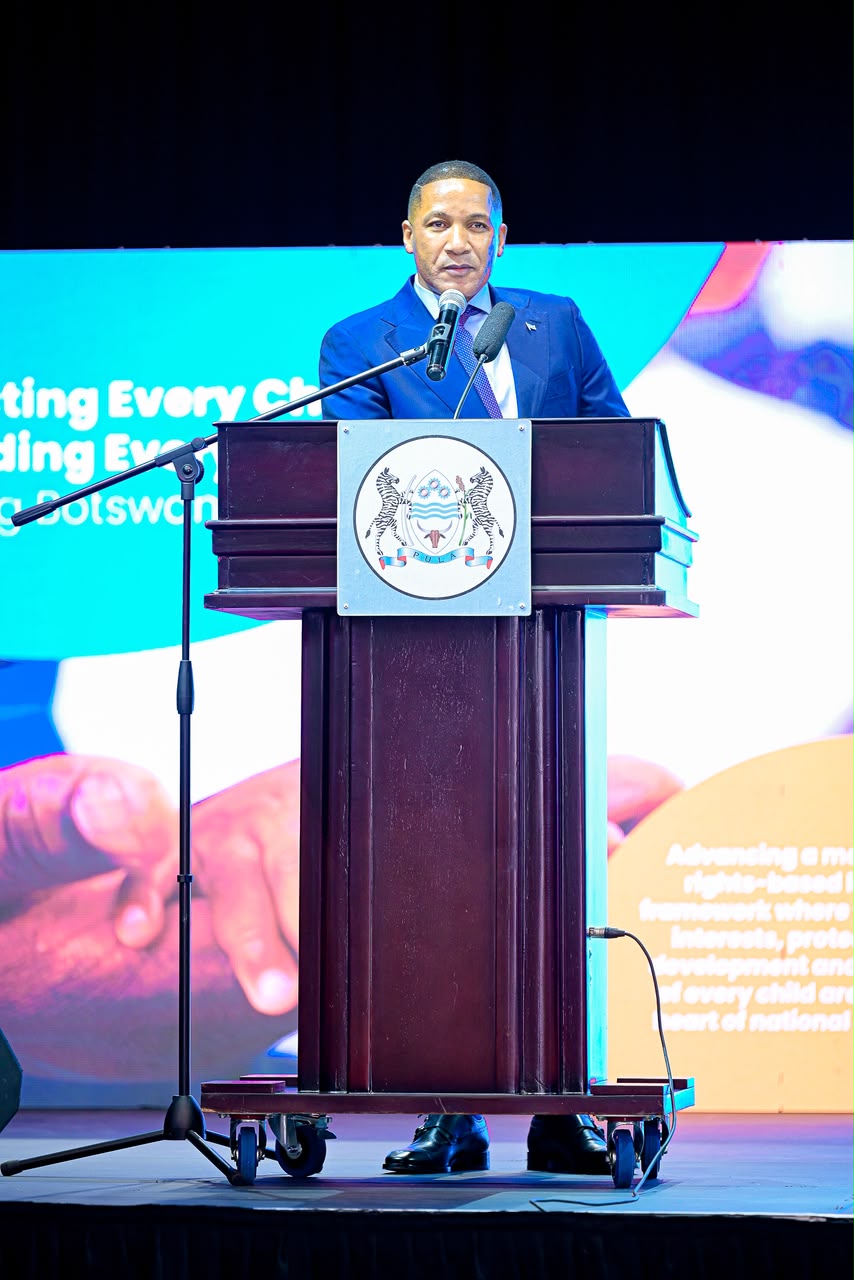

President Duma Boko dissected the complex landscape of child protection legislation in Botswana, blending academic precision with decades of human rights jurisprudence. Addressing an engaged audience, the President laid bare the structural realities, legal layers, and socio-cultural hurdles facing the nation’s child protection framework, issuing a clarion call for systematic legislative reform rooted in data and constructive problem-solving.
The Realities of Resource Scarcity and Competing Interests
President Boko opened his lecture with pragmatic clarity, grounding the discussion in the foundational economic reality of scarce national resources. He noted that public demands are vast, limitless, and frequently conflicting, with every sector vying for state support.
“The demands on the resources are limitless and huge and the interests that impose the demand are conflicting, everybody needs the resources, the resources are limited,” President Boko stated. “The debate it always seems, your leaders and politicians is to assert a demand and claim on the resources without acknowledging the scarcity of the resources.”
The President emphasized that increasing national resource generation must be the starting point to meet expanding social needs, followed by a rigorous, methodical approach to legislative reform.
Mapping the Legislative Framework
Turning to the corpus of the law, the President stressed that statutes cannot be read or interpreted in isolation. He highlighted the Children’s Act of 2009—which was enacted to domesticate the United Nations Convention on the Rights of the Child—alongside intersecting legislation such as the Affiliation Proceedings Act, the Matrimonial Causes Act, the Adoption Act, and penal provisions within the Penal Code.
According to President Boko, lawmakers and legal practitioners must map out how each piece of legislation impacts children. This requires a three-step methodological approach:
- Juxtaposition: Reading the law side-by-side with current demographic and social data to evaluate the present reality.
- Diagnosis: Identifying exact deficiencies and failures within the status quo.
- Constructive Solution Design: Drafting targeted remedies that reach down to the root causes of systemic challenges, while avoiding meritless emotive rhetoric against legislators in favor of progressive problem-solving.
The Hierarchy of Law and the Status of International Treaties
A central highlight of the lecture was the President’s breakdown of the legal layers governing Botswana, contrasting international obligations with domestic application.
He clarified that while signing and ratifying international conventions demonstrates commitment, it does not automatically incorporate them into domestic law—distinguishing Botswana’s dualist system from jurisdictions like South Africa. However, he referenced the landmark case of Attorney General v. Dow, noting that courts may invoke un-domesticated international obligations when called upon to resolve ambiguities in domestic statutes.
Alongside international law, the President mapped out national statutes, Roman-Dutch common law, English common law, and customary law. He noted that customary law presents unique interpretive challenges due to its unwritten and uncodified nature, frequently requiring recourse to historical authorities such as the works of Isaac Schapera.
Confronting Customary and Common Law Inequities
President Boko tackled sensitive socio-legal dilemmas deeply entrenched in historical jurisprudence, including the doctrine of “reasonable chastisement” under customary law, which he argued normalizes state-sanctioned violence.
He also addressed the persistent legal shadow of “illegitimacy”—the status of children born out of wedlock—which has survived despite legislative attempts to eradicate it. Under traditional customary and Roman-Dutch frameworks, unwed biological fathers historically faced severe legal disenfranchisement, lacking automatic guardianship rights, inheritance pathways, and custody access.
Drawing from his extensive career as a human rights lawyer, the President reflected on landmark litigation, including Mfundisi v. Kabelo (2003), in which he represented an unmarried father fighting for access and involvement in his child’s upbringing. He recalled how the court bypassed constitutional arguments via the principle of constitutional avoidance, instead relying on the overarching “best interests of the child” doctrine to secure paternal access—a progressive judicial pivot that preceded the enactment of the 2009 Children’s Act.
A Legacy of Legal Scholarship
Reflecting the depth of his background as a seasoned scholar and constitutional litigator, President Boko’s address bridged theoretical jurisprudence with daily lived realities. By grounding high-level policy discussions in the concrete struggles of families and children, the masterclass served as an authoritative blueprint for modernizing Botswana’s legal architecture and safeguarding its most vulnerable citizens.