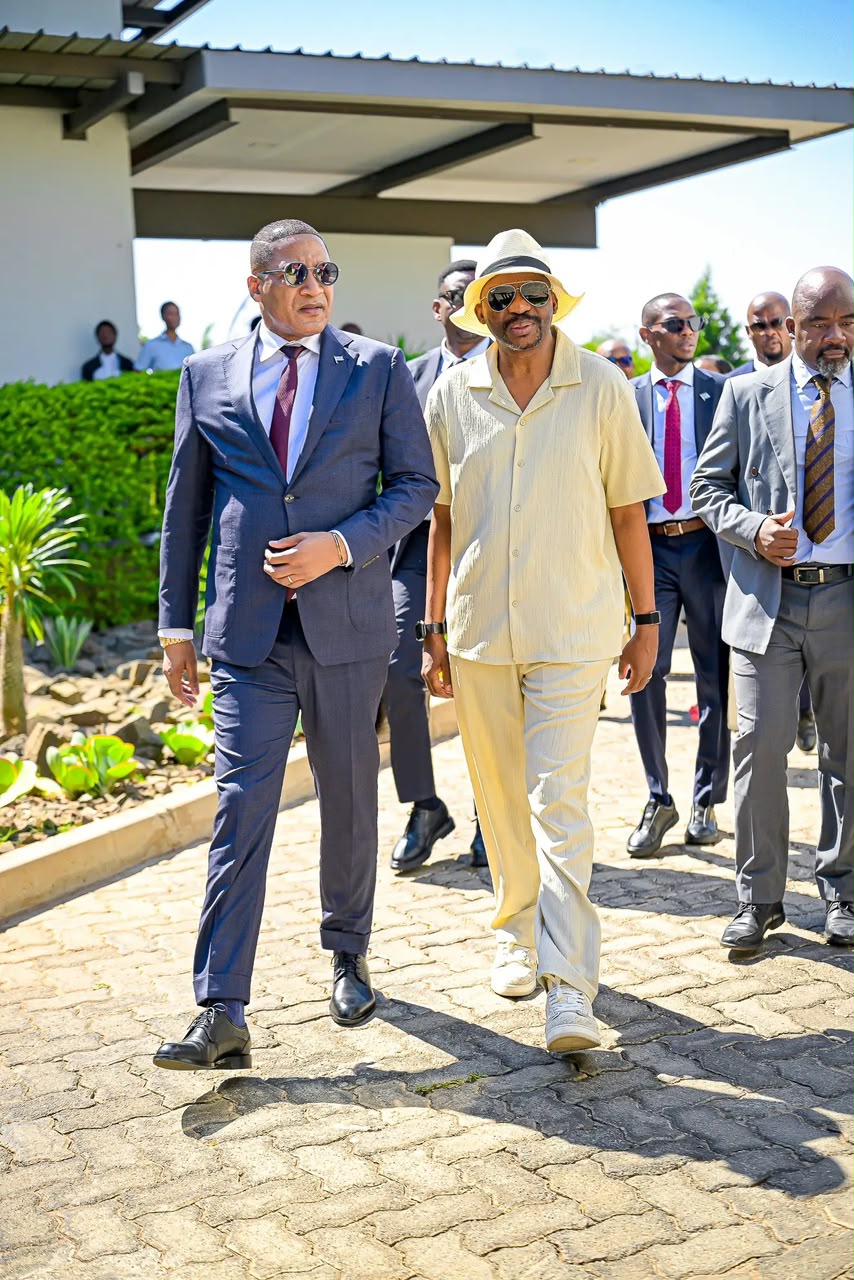

When Professor Bonolo Ramadi Dinokopila took his judicial oath before President Advocate Duma Boko at the Office of the President, Botswana’s High Court gained not only an experienced legal practitioner, but one of Southern Africa’s most prolific constitutional scholars.
Professor Dinokopila’s swearing-in marks a significant addition to the bench, an appointment aimed at deepening the jurisprudence of the High Court and expanding access to justice across Botswana.
Welcoming him to the bench, President Boko noted that while members of the judiciary must face rigorous public scrutiny without wilting, he held unreserved confidence in Professor Dinokopila’s ethical mettle and intellectual rigor.
The Anatomy of a Legal Journey
Professor Dinokopila’s ascent to the High Court bench rests on over a decade and a half of scholarship, courtroom litigation, and public institutional service.
- Academic Foundations: Professor Dinokopila graduated with an LLB from the University of Botswana in 2007. He went on to obtain an LLM in Human Rights and Democratisation in Africa (cum laude) in 2008 from the University of Pretoria, followed by a Doctor of Laws (LLD) from the same institution in 2013, focusing on international human rights law and the human rights mandate of the Pan-African Parliament. Broadening his commercial and administrative law expertise, in 2026 he obtained an LLM in Public Procurement Law and Policy from Stellenbosch University.
- Practice & Academia: An admitted attorney of the courts of Botswana, Professor Dinokopila spent formative years in private practice at Duma Boko & Company (2009–2012) and earlier worked in judicial administration as Assistant Registrar and Master of the High Court. In the lecture halls, he rose to head the Department of Law at the University of Botswana before taking up an Associate Professorship in Public Law at the University of the Free State.
- Public Service & Continental Standing: Professor Dinokopila spearheaded the formulation of Botswana’s Comprehensive Human Rights Strategy and National Action Plan. He served on the board of Botswana Railways (2021–2024), sat on the Botswana Tax Board of Adjudicators, and was nominated by Botswana for election as a Commissioner of the African Commission on Human and Peoples’ Rights (ACHPR).
Defining Themes in His Scholarship
Through dozens of journal articles, treatises, and edited volumes, Professor Dinokopila’s written work traces the fault lines of constitutional democracy, human rights, and customary jurisprudence in Southern Africa.
- The Rule of Law and the Role of the Judiciary
In papers such as “The role of the judiciary in enhancing constitutional democracy in Botswana” (University of Botswana Law Journal), Professor Dinokopila analyzed how the bench acts as an institutional anchor. He has consistently argued that the health of Botswana’s democracy depends on judicial review, adherence to separation of powers, and the courts’ willingness to adjudicate human rights disputes without deference to executive expedience.
- Socio-Economic and Indigenous Rights
In his co-edited volume, Introduction to Socio-economic Rights in Botswana (with Jimcall Pfumorodze), Professor Dinokopila interrogated the justiciability of basic entitlements in a constitutional system where such protections were not explicitly entrenched as directive principles, consistently arguing for an expansive interpretation of socio-economic rights into the domestic laws of Botswana.
His landmark case note, “The right to water in Botswana: A review of the Matsipane Mosetlhanyane case” (African Human Rights Law Journal), addressed the denial of borehole access to the Basarwa community in the Central Kalahari Game Reserve, cementing his voice as an advocate for marginalized groups and economic entitlements.
- Transformative Constitutionalism and Equality
Professor Dinokopila’s pen has frequently engaged with questions of gender and minority rights:
- In “The Unity Dow Case and the Constitutional Protection of Women in Botswana,” he reviewed the milestone judgment that dismantled patrilineal citizenship rules.
- In “The Decriminalisation of Homosexuality in Botswana” (Journal of Homosexuality) and his contributions to Intractable Problems of Human Rights (2025, PULP), he examined how civil society and judicial interpretation advanced equality and nondiscrimination.
- In “Customary Law and Limitations to Constitutional Rights in Botswana,” co-authored with Bonno Kgoboge, he probed the delicate boundary between traditional customary frameworks and constitutional rights.
- Contemporary Statutory Interpretation
Beyond human rights theory, Professor Dinokopila has applied critical scrutiny to everyday statutory mechanics. In his recent study, “The division of pension benefits upon divorce in Botswana” (Statute Law Review), he analyzed conflicting High Court jurisprudence and the interpretation of the Retirement Funds Act to resolve ambiguities facing separating spouses.
A Jurist for a Human-Rights Bench
Professor Dinokopila’s appointment comes at a moment when Botswana’s courts are called upon to handle intricate constitutional questions, statutory reforms, and international legal obligations.
For years, Professor Dinokopila’s papers dissected how judges ought to balance constitutional principles with lived realities. Now, as he steps from the seminar room to the High Court bench, he transitions from critiquing legal doctrines to shaping them firsthand.